Nepal Himalayas

Nepal Himalayas
Showing posts with label Everest Circuit. Show all posts

Sunday, 15 March 2015

Everest Circuit Rerouted XIII: Base Camp

Wednesday, 23 October 2013 17:30 Hrs at 4910m (Gorak Shep)

The terrain between Dingboche and Labouche is a narrow plain of grass and juniper and rock. Its ascent was fairly gentle except for the small hill immediately above the village of Tukla where we paused briefly for lunch. And by small hill, I mean something similar to the gradient and size of Sugarloaf (my father's hill) or the Lyre bird Track adjoining the 1000 Steps, Dandenongs. To the east of our trail and south of Tukla, a small collection of buildings and rock walled farm lots in the valley made up the village of Periche. It is said that when the Khumbu Glacier finally breaks free from its moorings further up the Khumbu Valley, the village of Periche will exist no longer, built in the path the glacier will travel. Our leader, Meet, advised that measures were being taken to reduce the likelihood of such an event, however one day the glacier would give way and there will be little more warning for those in its pathway than if it were a flash flood.

The way to base camp:
Labouche is a village that exists solely on the purse strings of tourism. Unlike Portse, Pangboche, Dingboche and Periche, farming is not sustainable. There are no farm lots, only teahouses and lodges that rely on the constant influx of tourists from Australia, UK and North America, Europe and Asia, all here to make the pilgrimage to Everest Base Camp or Kala Pattar or both.

The view into Gorak Shep:
Gorak Shep exists similarly as a launch point for many of those tourists. It was the original Everest Base Camp. In October and November, accommodation in Labouche and Gorak Shep must be arranged in advance due to popularity. The hike into Gorak Shep is fraught with pedestrian traffic jams, the fastest way in or out being as part of a caravan of yaks which have precedence and are always met by cries of, “Safe side, safe side,” as tourists and guides alike shift as far from the path as the snow will allow. The early snow has made the trail precariously slippery in places, either because the snow has melted too much or because it has iced over. We slipped and skidded our way into Gorak Shep at approximately 10:00hrs this morning following a 05:00hr wake up call.

After a short break for an early lunch, we then made the push for Everest Base Camp. It being autumn in Nepal and summiting season being late spring, there was no tent city to mark the camp. Instead, we recognised it by the colourful prayer flags and throng of milling tourists, each vying to have their photograph taken at the infamous ‘Base Camp’. There was, however, no formal signage. The camp itself being impermanent due to the shifting nature of the glacier on which it exists, there can be no one fixed sign. In the background, the would be Everest summiteers must negotiate a (mostly) solid wall of ice that from Base Camp appears deceptively small against the enormity of what we can see of the mountain, which is very little at all.

Base Camp:
To reach Base Camp, trekkers must contend with a rocky moraine and a rock fall. During less than favourable conditions, when the cloud comes in, I understand that it is very easy to get lost on the moraine. However, with the path cut into the snow, we could see the way laid out before us ridge to rocky ridge, and where it was not so clear, there was always a bobbing, moving tide of coloured beanies and caps, and bright gaiters and jackets to mark the way. These ridges went on for some time.

The rock fall crossing:
We could see Base Camp slowly advancing in the distance (I personally was able to identify the camp by the icefall behind it) while at every crest there was a new gully and a new ridge awaiting us. Not that the trek could be undertaken head up. Much of the trail was either rock or ice. Rock was preferable – we could skip between them easily enough, particularly using one walking pole for balance. Ice was more difficult. It was not always immediately obvious whether the snow was slush or frozen over again. Both falls I had were on ice and in both instances it was my camera I tried to save first. Successfully, I might add. The snow for all its hazard, however, added to the spectacular view. The moraine, a sweeping tundra of grey rock, was utterly transformed into snowy rock cropped valleys and ridges and ice lakes with ice waterfalls. It was truly magnificent.

Returning to Gorak Shep:
(Postscript: The contrast provided by the snow made for spectacular photographs. While it was disappointing that we were not able to summit Gokyo Ri or cross the Cho La because of it, and we were prone to falling over, I do not regret the experience of hiking through the snow. As someone that loves a good picture and carried a DSLR by hand most of the journey, the memories I captured on camera have such amazing depth and contrast, I doubt I could have achieved otherwise. If you are an avid photographer, it would be well worth bearing that in mind when considering making the pilgrimage for yourself. The snow we experienced was certainly not the norm for that time of year and was the result of typhoons throughout South East Asia.)

Saturday, 28 February 2015

Everest Circuit Rerouted XII: The Most Beautiful Mountain

Monday, 21 October 2013 11:47 Hrs at 4330m (Dingboche)

The trail from Pangboche to Dingboche meanders along the Imja Kola. It is, at least in October, a well travelled route as today we passed by a very many trekkers, porters, local people and yaks both ascending and descending the Khumbu Valley. Opposite, Ama Dablam remained our constant companion, growing as we drew ever nearer. It is a no wonder that the monolithic peaks must be summated from the other side. Much of the mountainside backing onto the Khumbu Valley is covered in great rock slides. Although, trails can still be seen cleaving the snow on its sides.

Ama Dablam:


Dingboche is one of the largest villages we have had the pleasure of residing – if ever so briefly – in. At above 4000m, it too had seen snow fall. However we were spared trudging through it by the beautiful weather, for today it really is very beautiful. Hardly a cloud to mar the pristine blue sky as it clings only to the surrounding peaks. What snow remains, hides in the shadows of the Mani walls or juniper bushes or buildings, waiting for its inevitable turn to melt. It cannot be denied that we, all of us, were excited and relieved to spy the distinctive orange tents marking our campsite. The walk was not long nor was it arduous. But hiding noses burnt by our last foray into the snowy altitudes in excess of 4000m is no easy task. It was not enough to wear a cap or liberally apply SPF50 at 2 hour intervals to remain protected from the UV rays, or so I discovered. Instead, I tried to pull my buff up over my nose and ears, and tuck it beneath my grey cap and polarised sunglasses which was all very well and good until we started climbing again, as we invariably do, and the sun made breathing through the thin material a stifling, suffocating experience and I was forced to tear it down over my chin again, panting to catch my breath.

Having spent some time already of 4000m, and over a week above 3000m, I have developed some functional acclimatisation. We all have, as is evident by our faster ascent these last 2 days. The steep inclines are wearing, and paying heed to all the long distance running I did in training, I constantly remind myself to keep my breathing under control. It is not possible to align it to the pace of my steps, the terrain being largely irregular and thus so being my stride. But I normally aim for a 2 beat rhythm. In, in. Out, out. In, in. Out, out. The neck buff comes off when my breathing becomes erratic.

When it comes to mornings and evenings, however, as the villagers burn juniper, I am not so quick to remove it. The burning juniper, while having a rather pleasant aroma, does little for our dry throats. Central to Buddhism practiced in the Himalayas, juniper is considered purifying. It is said that when the Lama entered Nepal from Tibet, he cut his hair by the stupa he built in Pangboche and from it juniper sprouted. Even in Dingboche, well above the tree line, the hardy little shrub continues to grow. Indeed, I can see juniper grow right up until the black rock begins, several hundred metres above the town, where no other sizeable vegetation can be seen.

Perhaps tomorrow in Labouche, we will see the end of the juniper, our ascent 600m from Dingboche. This exceeds the mountain rule of 300m, however it will be, I understand, only 150m higher than our greatest altitude which we experienced in Gokyo only 3 nights ago. The trek will take approximately 6 hours with only a little melting snow, and then we will be back on our itinerary. Whether we next visit Kala Pattar or Everest Base Camp will depend on the weather. Having missed the opportunity to safely ascend Gokyo Ri, it is more important to ascend Kala Pattar on a clear day. Although, it must be mentioned that another guide we encountered during lunch at Portse 2 days ago advised our leader, Meet that the snow at Kala Pattar was waist high. Let us hope that it has sufficiently melted in the next few days. Likewise, we heard tonight that Everest Base Camp had been re-opened, following the unseasonable snow last week.

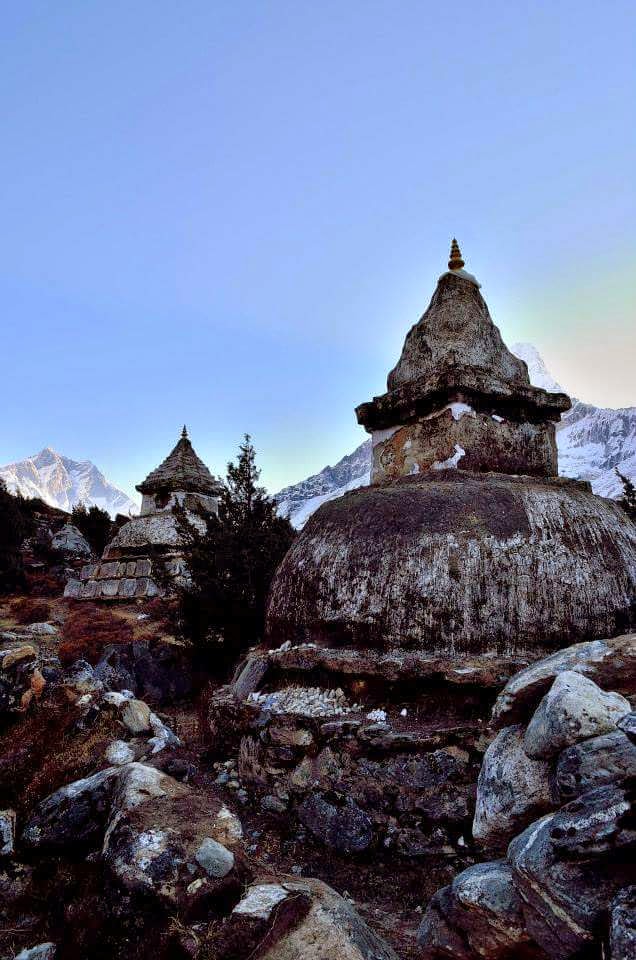
Stupa near Dingboche looking toward Taboche and Cholatse:


It is truly amazing how word of mouth is so important here. There is very little in the way of a scientific weather mapping system. Meet relies on the knowledge of the local villagers or our sirdar and guides, and other descending leaders and guides. This applies also to avalanche zones, through which our sirdar, Padam with his 30+ years of experience went ahead to review the conditions. It was only on the return journey that our other sherpa guide, D.B. shared his experience when a camp for which he was the cook made the sudden decision to abandon a camp between Machermo and Gokyo, and the kitchen team remained behind to mind the gear. D.B., after digging himself out of the subsequent avalanche, saved 4 more of the 5 remaining buried. It does not surprise me then that he was so uncomfortable in Gokyo.

The Nepalese are truly a wonderful and giving people. Today being my birthday, Meet presented me with a khata (a cream traditional ceremonial Tibetan Buddhist scarf) similar to those that I have seen tied alongside the prayer flags on the suspension bridges and around religious monuments. He told me to wear it for the day which I happily did, tied neatly around my neck and tucked into the front of my shirt. It is presently folded away in my camera bag for safe return to Australia. And then to my utter surprise, this evening, Krishna the cook walked in with a sponge cake made without the use of an oven by a process that sounded very much like steaming the cake. It was one of the most lovely gestures of my day, after the khata and Meet giving me his own tent so that I could have one of my own. I do not know how I could ever possibly reply the generosity and kindness that he has demonstrated to me in just 12 short hours. I am just so overwhelmed by how caring almost total strangers can be, Nepalese and Australians alike (I’ll even include the naturalised Australians here, as our group does contain 2 very fine specimens).

It was a small shame that I could not get any reception on by phone here, but the weather and the company and the cake was all so very fine that it is such a small thing to miss. And no doubt my international roaming will kick in sooner or later and I can check for messages from my family and closest friends. But now it is getting late and I must retire. It has been a very long day.

Tuesday, 10 February 2015

Everest Circuit Rerouted XI: Khumbu Valley

Sunday, 20 October 2013 17:30 Hrs at 3930m (Pangboche)

After a morning of retracing our steps to Porste Tenga, we made the climb to the village of Portse where we had lunch overlooking the small potato farming town. The potato harvest had taken place a day or so before as in a number of small rock-walled paddocks, villagers continued to sort their harvest as we passed them by. We then proceeded up the Khumbu Valley to where we are presently wilderness camping in a field in Pangboche.


The trail was narrower here than in the Gokyo Valley and the drop more sheer. Above the tree line, yaks and naks challenged gravity as they grazed both above and below the trail on a mountainside that was for any large biped, such as ourselves, impossibly steep. It was here that we saw our first glimpses of Ama Dablam and Lhotse amidst the afternoon cloud. They loomed high above the Khumbu Valley and one could almost believe that they erupted from the sky and not the earth. Their infamous neighbour Everest, however, could not yet be seen.

Pangboche is home to a very small, very old monastery. Older even than the more famous monastery in Tengboche. Upon entry into the village from our camp, we passed by a large prayer wheel that is continuously turned by the water rushing beneath it. Mani walls line much of the short walk there and we see also two small stupa fallen into varying stages of disrepair. As with all Nepalese villages visited thus far, prayer flags hang from almost every rooftop and from the trees. Yaks also populate the small paddocks and they wander freely the narrow streets, occasionally to be shooed away by one of the villagers.


The people of Pangboche and Portse are, according to our leader Meet, Sherpa climbers. These are the people that take Westerners to the summit of the great peaks such as Ama Dablam, a technical peak more difficult than Everest. They are a small and hardy folk, with the wide, flat faces of their Tibetan heritage as it passed into this valley 400 years before.

(Postscript: Leaders, sherpa guides, cooks and porters supporting non-technical treks in and around the Khumbu region are often from the mid- and lowlands. It is not uncommon for them to be sustainence farmers that find work during the busy tourist trekking season to better support their families and send their children to be privately educated that they can live a life of greater choice. Our leader was from the Annapurnas, while our guides were a few days walk further down the valley from Lukla.

Sherpa people from Khumbu are generally accepted as being climbing guides and elite mountaineers supporting more technical treks and climbs at higher altitudes. Their greater acclimation could be attributed to both genetic high altitude adaptation as well as being born and raised at higher altitude and therefore having a greater base of acclimatisation to build upon. Climbing guides make substantially more than their less technical counterparts. Many young men from the Khumbu villages go on to be expert mountaineers but it comes at greater risk as evidenced by the 2014 avalanche in the Khumbu Icefall's Popcorn Field.)

Thursday, 5 February 2015

Everest Circuit Rerouted X: You Shall Not Pass!

Saturday, 19 October 2013 14:35 Hrs at 4000m (Dole)

The snow we initially encountered just above our last visit to Dole grew substantially deeper as we made the push for Gokyo yesterday. There was some debate regarding whether we should try for Gokyo at all or reroute directly from Machermo. The passage to Gokyo passing through an avalanche zone after a few days warm weather since the snow was deposited in the valley – the worst snow experienced at this time of year for 17 years, according to the locals – we relied on local knowledge and the experience of our leader and sirdar. It was clear on both our journey to and from Gokyo that there had been a number of small avalanches. Ice steps had been tramped or cut into the sides of some of these, as other trekkers or porters cut the trail earlier in the morning. We had to pass through the avalanche zone in the morning before the sun made the snow too slick. As it was, even though we re-crossed it this morning earlier than yesterday, the ice steps were not as firm and we, at times, found ourselves skidding frequently, even with our trekking poles out to assist us.

Cho La being completely closed at present and more snow forecasted, a decision was made to spend only one night in Gokyo and to forgo the ascent of Gokyo Ri to ensure we were well clear of Gokyo before it became snowed in again. After an early start of trekking at 07:00hrs, we had descended to Marchermo by 09:50hrs (the slower group arrived nearer to 10:30hrs) and had an early lunch. We subsequently departed Machermo at 12:00hrs and after an initial ascent, descended to Dole by 14:00hrs. The recent good weather saw much of the snow melted within an hour of Dole. The path had become slick with mud instead of snow slush. Being a Saturday, it was fortunate that there were not so many yaks muddying up the trail any further.

View of Gokyo Valley:


Tonight we stay at a permanent campsite in Dole and tomorrow we will return to Portse Tenga where we will take the trail up the Khumbu Valley. We will make a wilderness camp at Pangboche. Then we will spend a night at Dingboche and pick up our itinerary at Labouche, which is before Gorak Shep and Everest Base Camp.

Gokyo Ri, as of yesterday, was only summitable by mountaineers. The trail had only been broken to within 20 metres of the summit and with the snow already waist deep in Gokyo, it was even more heavily snowed in again. As unfortunate as it was not to be able to climb Gokyo Ri or pass through the Cho La, we still have opportunity to make Everest Base Camp and Kala Pattar without adding any really long days to our schedule. Today was 5 hours of trekking for the faster group lead by Basu. Had we remained in Gokyo to ascend Gokyo Ri, there would have been a 9 – 10 hour hike to Portse Tenga and an 8 hour hike to Dingboche (if we did not get snowed in). Due to melting snow, we could not have as safely departed from Gokyo in the afternoon.

The lakes of Gokyo, however, were well worth seeing and it was no great loss to pass them by twice. There are, I believe, 5 in total. We saw the first 3, the township of Gokyo overlooking the third on one side with Renjo La on the other and Gokyo Ri appearing deceptively small just up the valley in front of Cho Oyu. When the afternoon sun struck the third lake, it was a beautiful green amidst all the white snow and black rock. Truly stunning. I spent the afternoon traipsing through the paths cut by the locals, tripod in one hand, camera in the other, tyring to take a photograph that would do this beautiful lake justice and sinking waist deep into virgin snow for my troubles. (Trying to get back out of waist deep snow without using my hands must have been quite a sight as I was not long legged enough just to high step out of it!)

The perfect shot:


Surely it must be snowing in Gokyo presently. It is now after dinner and we have retired to our tents. After a good 15 or 20 minutes organising my gear on the spare bed for morning, it is still only 19:20hrs. Outside, the cloud is very low, clinging to our head lamps as we negotiate our way to the dining hall, the toilets and the tents. There was even light precipitation and tomorrow, I am told, it may rain again. All this drawing the Nepalese to the conclusion that it must be snowing at higher altitude and, therefore, it was lucky we left today before we were snowed in.

Routine has become very important to us. So much of our daily activities being outside our control or influence, we rely on the routine set for us and are as a group happiest when the routine is met. “6, 7, 8.” That is Meet’s way of informing us that we will proceed with our normal morning routine of tea at 06:00hrs, breakfast at 07:00hrs and departing camp at 08:00hrs. Washing water normally appears at our door (tent or otherwise) at 06:15 and 15:30hrs. Afternoon tea is at 16:00hrs. Dinner at 18:00hrs. Lunch depends on when we arrive at certain destinations and could be anywhere between 11:00 and 13:00hrs. We have learnt to take our own snacks for morning tea. I have a stash of mini Mars bars and Toblerone which I take one of each with me every day. Often I will take something squirreled from breakfast, like a boiled egg or peanut butter and jam on toast. I have never eaten so well as I have here, although yesterday at almost 5000m, my appetite was waning. I could hardly stomach one piece of buffalo and after that, everything else on the plate did not appeal to me. The others fared similarly.


Postscript: A lack in appetite at 5000+ metres is associated with the altitude. I personally had stomach only for soup and Pringles, and was not the only one in our group that felt that way. I think we all craved salt from sweating under the even moderate exertion of the trek.

Thursday, 23 October 2014

Everest Circuit Rerouted IX: Machermo Porter Shelter & Rescue Post

Thursday, 17 October 2013 19:57 Hrs at 4470m (Machermo)

As rain fell in Namche Bazaar, so did snow in Machermo. It is knee deep in some places and in others maybe more. The peaks surrounding Machermo are little more than black rocks to the locals but with the recent dusting, it has become completely transformed into a valley of exquisite views. The white cut through by small stone buildings or walls, or by the heavy tread of yaks and trekkers and Nepalese alike.

The yaks intrigue us greatly to the horror of our sherpa guide, Basu. We all stand on the path with our cameras poised to capture a truly Nepalese photograph as he calls to us: “Safe side, safe side,” by which he means for us to keep to the uphill side of the trail in the event that we do get knocked over by one of these great, plodding beasts. Better to fall up the hill than down it. Although it certainly is interesting trying to step off the trail into thigh high virgin snow.

Of limited experience as I am with snow, I found it absolutely fascinating trekking through it. We passed the snow line quite early, within an hour or so of leaving camp, and I was surprised by how warm it was. I need only pull the hood of my Patagonia R1 over my head and sleeves down when the wind came up the valley. It was, otherwise, too hot to trek in a hard or soft shell. The trail was slick with mud and every step was with careful consideration. The use of a single hiking pole helped keep me on my feet when the step taken was not considered carefully enough and I skidded or slipped, most often on the declining slopes. I tried to remember to dig my heels in, but when it came to the last descent before camp – which Basu himself almost skied down in his leather hiking boots – I went off track using the deep steps made by other intrepid trekkers.


In Machermo there is an established porter refuge and medical centre called the Machermo Porter Shelter and Rescue Post. It offers porters with free accommodation and medical treatment including treatment of Acute Mountain Sickness or AMS, as provided by volunteer doctors from the UK. Westerners and travellers may utilise the medical services also but for a fee comparable to that in the US (at approximately $50 per consultation which is redeemable on travel insurance). A fee that assists to maintain the rescue post so that it continues to be free for the porters. Every afternoon at approximately 15:00hrs, the volunteers provide a free presentation on AMS, HAPE and HACE, and on the general wellbeing of the porters. For a nominal fee of 100 rupees (or USD$1.00), they will measure your blood oxygenation levels which are recorded as part of a study on normal oxygenation levels and acclimatisation at 4500m per age group. The wall was covered in names recording their value. Mine was 90-91% without Diamox (I have yet to require it); a very average figure judging by the number of names stuck to the wall against 90%. The highest in the group was 97% (on Diamox) and the lowest 80% (without Diamox). One of our porters was 97% also and the doctors were so pleased with his acclimatisation and his gear outfitting, as provided by World Expeditions, that they requested to take his photo in front of the centre.

The talk itself was really very moving. It amazed and horrified me that porters are often left to find their own accommodation at night and where there is none available, sleep in caves or under the stars. I could not imagine being so barbaric. Since the founding of the International Porter Protection Group approximately 10 years ago, tour groups more and more, have been better at outfitting and caring for their porters as trekkers with greater awareness know now to ask these questions of trekking agencies. Still, however, sick porters are turned away to make their way down alone, sometimes suffering HACE or HAPE. Only in Dole we watched on with disgust as another trekker made it clear to his porter he would rather the porter-guide not share his room that night nevermind that the porter was trying to convey to him that there was nowhere else for him to stay.

(Postscript: The volunteer doctors advised us all of an incident in which an unsupported trekker, having attended the AMS talk at the Rescue Post, came across a very unwell porter on his ascent toward Gokyo. The trekker had been unable to communicate with the porter but he soon located another Nepalese porter or guide and was able to communicate his concern that the unwell porter may have AMS. The porter was carried down to Machermo by the Nepalese porter or guide and despite being placed in an oxygen tent, needed urgent evacuation to lower altitude. The volunteers were able to fundraise the money required to evacuate the sick porter by helicopter within the day by approaching other trekkers that passed through Machermo which ultimately saved the sick porter his life. Porters often come from the lowlands and are not acclimatised when they commence trekking for a company. They are just as susceptible to AMS, HACE and HAPE and can die if they are abandoned by the tour group and forced to find their own way down the mountain because they are too sick to continue.)

Sunday, 29 June 2014

Everest Circuit Rerouted VIII: Yak Yak Yak

Wednesday, 16 October 2013 14:40 Hrs at 4040m (Dole)

The road between Phortse Tenga and Dole is relatively short. Only three hours separated them. It is also much less traveled than the road from Namche Bazaar. As we wandered along the path – slowly, slowly as always – the panoramic Himalayan vistas that were concealed from us the day before were finally revealed. We are now only a few hundred metres below the snow line, and at over 4000m, the foliage has changed. There are no more soft pines or conifers or what appeared to be paperbark. The trees are smaller, scrubbier, and very soon will end altogether.

Dole is a sleepy little place, smaller than even the main drag of Amphitheatre, Victoria (the nearest town to where I grew up where the population is a little over 200). Constantly bells ring from the necks of grazing yaks and dzopkos. There are very many yaks here, and appreciative few which I would judge from their uncollared necks and the way at least one local chased them from his land, are wild. They are far hairier than their bovine cousins, with tails much like that of a horse, and great horns protruding from their heads. They have voracious appetites as they grazed almost continuously since our arrival a few hours earlier.


Having arrived at Dole before midday, and the weather much finer, a number of the group took the opportunity to wash soiled clothing by the river. We then laid them over rocks, as the Nepalese do, so that they would dry. The walk down to the river and back would have been much more pleasant had the 2 litres or so of fluid consumed before lunch not made for such a hasty retreat to the facilities which, in Dole consists of a small building with a hole cut into the floor. There is leaf litter piled at the back of these ‘facilities’ to cover any more substantial deposits through the gap. These composting toilets, I understand, are used to help fertilize the land on which vegetables are grown for human consumption. A practice long utilised by the Nepalese people.

The less that pristine weather has made much of the land unsafe to tread, circumventing any afternoon excursion aside from the short laundry trip. As we meandered up steep steps and great wallows of mud, the mountainside on the other side of the valley was subject to a landslide, the crack of falling rock as loud as gunfire. Aside from the road to Machermo where we will be trekking tomorrow and the road back to Phortse Tenga, there is no other real tracks to take and so any excursion would have been on very smaller, lesser used trails. Meet was concerned we could dislodge rocks.

The trails have been, thus far, steep but doable. Our lungs run out of oxygen before our legs their strength. The reduced oxygen is very noticeable on exertion, as though you were carrying an additional 16 or 20 kilograms and it will only worsen as we are to ascend another 1600 metres. Our pace, thankfully, has been slow. Regardless, we generally make each day’s trek within the approximate times as outlined in the trek overview. Even with a cold, I have had no difficulty keeping pace with that set by our sherpa guides. Today D.B. lead us and Basu was located somewhere toward the back of the group. Meet watched us all walk in turn, ever mindful and observant of signs that any one of us may be exhibiting AMS. The drone of helicopters in the valley is becoming our constant morning companion, as ever more trekkers are airlifted from the hillside.

(Postscript: This was the day I commenced the course of Cold and Flu tablets I brought with me in the hope that I could relieve my symptoms before Cho La. While my cold symptoms did subside a little, the cough persisted until I returned to Kathmandu. Developing a persistent cough is quite common in the Himalayas, I understand. It is often called the Khumbu Cough for those that develop it in the Khumbu Valley on the way to Everest Base Camp. I have since been advised by a fellow hiker that a ventolin inhaler could assist with persistent coughs developed at altitude.)

Everest Circuit Rerouted VII: Rain, Rain, Go Away

Tuesday, 15 October 2913 19:10 Hrs at 3650m (Phortse Tenga)

The Dudh Kosi, our almost constant companion since Ghat, rages beneath the campsite, louder than I have ever heard it. Water runs down the nearby mountainsides in great rivulets. There are always a handful of waterfalls in view at any time, falls that I am told freeze in winter attracting ice climbers. Water runs down the tracks also, so deep in some places that we rock hop across to the next patch of damp dirt. At one point during the trek from Namche Bazaar to Portse Tenga, we had to climb up a flight of stone steps holding onto a low handrail as the waterfall broke over our heads and brushed our shoulders and ran over our feet. Our sherpa, Basu was not particularly amused being the last of our group to brave the sodden crossing.

It has rained almost constantly since we arrived in Namche Bazaar on Sunday. Not heavy rain, and often no more than incessant drizzle, it has slicked the tracks with thick mud and left us wet to our baselayers. A frenzied search for the ‘perfect’ poncho through Namche’s winding streets yesterday saw at least T and I – and our packs – mostly dry with minimum condensation. Much less than my Montane eVent jacket, the condensation on which transfers too readily to my mid and baselayers, subsequently leaving me cold on stopping (as I discovered on our forays in and around Namche on our acclimatisation day there). The last minute find earned the tick of approval of Basu, as he told me more than once today that the poncho was a very good rain jacket. He, himself, made do with what appeared to be a heavy duty plastic bag intact on two sides, which he drapes over both his head and his pack. We saw a very many variations of this among the other sherpas and porters and Nepalese people treading the wet trails, as well as a surprising number of umbrellas more often than not furnished by one of the locals. The Westerners, however, proceeded in their rainbow parade of Gortex jackets and Nepalese made ponchos (whose zippered sleeves disqualified them from being the perfect ponchos) and waterproof overpants. There was a surprising amount of foot traffic, even following the separation of the Everest Base Camp and Gokyo trails, in both directions. We witnessed as a helicopter landed in a nearby village, presumably to collect a trekker suffering from AMS (only the first of many to come). Our own pace is steady and we do not rush the trails. Even with the extra traffic and poor weather conditions, we still managed to conclude the trek to Phortse Tenga within 5 hours and without any great exertion.

The trail itself is much more difficult than that to Namche Bazaar. And while there was talk of this awful ascent into the town and to our eco-lodge, it was no more difficult than the 1000 steps in the Dandenongs, Victoria, the greatest challenge being unable to see the end. I do believe our gentle introduction to Nepal is at its end, however. The next few days, at least, are relatively short ones which will be fantastic for acclimatising, with afternoon ‘excursions’. Today was the first day I did not go on the excursion. After the long wet slog in the rain with a sore throat and runny nose, I felt it more prudent to rest. As such, for the second time now I pulled my camera tripod out of my kit bag and took a few photographs with the adjusted exposure time. I am looking forwarded to seeing them enlarged when I return to Australia.

Tuesday, 24 June 2014

Everest Circuit Rerouted VI: Namche Bazaar

Sunday, 13 October 2013 14:03 Hrs at 3445m (Namche Bazaar)

The Nepalese people of the Himalayas are a compact hardy folk. Much smaller than those of the lowlands. Whether by genes or other environmental or organic factors, such as reduced oxygen saturation of the air or carrying heavy loads from a young age, there is a marked difference. Their facial features differ also. The higher we get: broad flat faces with beautiful catlike eyes and rose cheeks. Men and women alike are much older than they appear by Western standards. It is becoming easier to distinguish the porters and the guides that have come from the lowlands and middle hills from those native to Khumbu. Indeed, our leader, Meet is from the Annapurnas and our sherpa guide, Basu is a lowlander. He is much taller than the locals. Head and shoulders above some of them.


The higher we ascend, the more we see youths carrying loads that would make a grown Western man cringe. Mere boys of thirteen or so hunched beneath the great weight of bottled drinks and chocolate and toilet paper for our consumption. And it is largely for the hoards of tourists that they haul these things – the Nepalese do not use toilet paper, they use water – the cost progressively increasing the higher we ascend. The mules and dzopko (cow-yak crossbred) we often give way to on the trails appear, more often than not, to be transporting fuels such as kerosene or pressed dry grass for fodder. These beasts of burden also carry the yields of vegetables we see growing in the terraced paddocks to be sold at Namche Bazaar. It is quite a sight to watch as the laden animals negotiate the slippery rock stairs and the great hanging suspension bridges that cross and re-cross the Dudh Kosi, all to the whistles and calls of their handlers.

The mules must be easier to manage than the dzopkos as they are driven in herds of between six and ten, and appear to respond to a command to stop and another to proceed. The dzopko, however, appears usually in groups of two and three. They are a fascinating animal. Short coat like a cow, often black and white or closer to a buckskin colour similar to a jersey cow. Their tails are closer to that of a horse or mule than a cow, and they have narrow forward facing horns as inherited from their yak fathers. Yaks do not live below 3000m and having only ascended above 3000m today, we are as yet to see any.


Last night in Monjo we shared our camp with another World Expeditions tour descending from a trek to Gokyo Ri. They arrived in the camp late, well after 16:00 hrs and had been hiking 9 hour days after their 11 day trek was delayed 2 days in Kathmandu due to weather. They looked especially weary compared to our group, most of whom had elected not to undertake yesterday afternoon’s excursion. This was the first of the other World Expeditions tour groups we came across, however today we have passed porters transporting the distinctive red and black kit bags toward Lukla, and at least one other group have arrived at the eco-lodge in Namche Bazaar today. This last group did not have our fortune with the weather. The clouds that clustered around the mountainside yesterday at approximately 16:00 hrs did not lift and by 11:00 hrs this morning there was drizzle. The sky opened a little after we arrived here at 12:00 hrs and this group has not long arrived.

The eco-lodge is a sherpa hotel and is affiliated with the Namche Bazaar Museum to which we will be shortly visiting. The accommodation is sparse, much like our tents, only the room has a toilet for our convenience and panelled windows which afford spectacular views, even with the hanging grey sky. Yesterday’s wet washing hangs from the line I have strung between the window handles hoping to dry. My kit bag is stored neatly at the end of my bed with my boots. My day pack is beneath the window next to the other end of my bed and I am making full use of the spare down blankets with their velvet maroon covers to keep me warm, as the room is without heating.

Saturday, 7 June 2014

Everest Circuit Rerouted V: Is it Yellow?

Saturday, 12 October 2013 17:17 Hrs at 2850m (Monjo)

The terrain encountered today was much the same as yesterday. Stone and dirt paths that cut through the mountainside, trees or sheer rock on one side and the view on the other. We have been following the Dudh Kosi (Milky River) since our departure of Ghat, crossing it a number of times. The sheer torrid force with which the river flows renders the glacial blue waters white and the roar can be heard throughout the valley. Its musical sound is one I doubt could ever grow tiresome. Crossing the river, however, is slightly less pleasant as it involves crossing suspension bridges – often behind mules or other tourists – which shifts and sways beneath our feet, especially as we near the centre of the bridge. I have taken to focusing on the pack in front of me and shuffling as quick as possible across the bridge, occasionally pointing the camera one way or another and shooting without actually peering through the view finder.

Our leader, Meet, has done his best to allay any fears and preconceived notions regarding our ascent into Namche Bazaar tomorrow. He insists that when it comes to that last steep climb, that by looking down at our feet and not at the seemingly never-ending rise before us, will make it easier for us. I think he has been pleased with our pace thus far. Today we traveled from Ghat in around 4 hours, and that was with a long break to allow one of our group to recover from a sudden spell of light-headedness. She is only carrying a single 1 litre water bottle and it has been very warm in the sun with little breeze through the trees. Yesterday at Lukla it was 27˚C. Today might have been a little less. It is apparent, however, that tonight will be much colder than last night notwithstanding the clouds that cling to the surrounding mountains where only 2 hours before there was blue sky. Our faded orange tents are bright against the blue-green pine trees that line the mountain.

We arrived in Monjo just after 12:00 hrs and sat down to a lunch of roti bread, spinach, potatoes and spam. That last was new for me but given the scarcity of fresh meat, aside from perhaps poultry, I ate it with the ravenous appetite 4 hours of trekking gave me. Afterward, I went for a small 1.5 hour acclimatisation excursion with Basu, Meet and one other of our group up a nearby hill. As with yesterday afternoon’s side trip, the walk was much slower with a greater number of breaks. I use the extra walk as an opportunity to take photos and, hopefully, acclimatise better.


I do not know if I should be concerned that I have had no more than very mild passing headaches and the occasional disturbance in spatial awareness (as though I were slightly intoxicated). Most of the other trekkers have experienced a variety of much more pronounced symptoms. One experienced such severe light-headedness so as to require her daypack to be carried by the sirdar, Padam for a time. Another experienced strange dreams last night and the sensation that the tent was spinning. Both have since commenced taking their Diamox. A third felt intoxicated yesterday and generally unwell. While a forth has had stomach upsets that persist in spite of the Immodium. Yet another is experiencing fatigue. I cannot state for sure if the last is having any symptoms aside from perhaps the sense she might be coming down with a cold or, as Meet put it, the Khumbu cough. The dry air is leaving blood in my nasal mucous just as when I am in an airplane.

The camp works to a routine. At approximately 06:00hrs, we are awoken to a cup of black tea. Warm washing water is then provided in large silver bowls fifteen minutes later. We are to pack our kit bag and present for breakfast at 07:00hrs. The trekking party departs at 08:00hrs, our kit bags already collected by the porters. Following a day of trekking, we receive glasses of warm orange cordial. More hot washing water is provided at 15:30hrs and then afternoon tea at 16:00hrs. Dinner is between 18:00 and 18:30hrs. Coffee, tea and hot chocolate is provided at the end of all meals, at which time our empty water bottles are collected and filled with hot water. We are encouraged to drink constantly and as a consequence must relieve ourselves quite frequently also. Discussing our hydration status as determined by the colour of our urine makes for an interesting bonding experience. And then it comes time for bed and, if early days are any indication, it will be very early nights for us all for the next few weeks as everyone trundles off at approximately 19:30hrs. Who could blame us.

Thursday, 5 June 2014

Everest Circuit Rerouted IV: Into the Mountains

Friday, 11 October 2013 12:47 Hrs at 2600m (Ghat)

The sheer magnitude of the Himalayas cannot be overstated. It is so utterly breathtaking that I do not yet feel myself intimidated by its towering presence around me, only in awe. Would I that its exquisite inclines continue to inspire me to push ever forward. ‘Slowly, slowly,’ as proclaimed by the signed shirts that we see tacked to the walls and ceilings of the tea-houses or eco-lodges affiliated with World Expeditions. Today at least was not a baptism of fire.

We have been spared the flames until the day after tomorrow when we make the trek up to Namche Bazaar where there awaits us a very steep and – at least seemingly – never-ending trail. We covered approximately 4.8 kilometres today trekking from Lukla to Ghat with approximately 200 metres descent in total. The walk was at a very reasonable, slow pace. Even at 2600 metres in altitude, the air is noticeably thinner on exertion. We all have vague headaches and many a light headedness that might otherwise be attributed to mild intoxication if we had been drinking. It took us approximately 2.5 hours to trek down to Ghat, stopping twice for around 15 minutes each. The weather is still quite warm in the sun.

The flight to Lukla from Kathmandu was stunning. Flying much lower than the Silk Air Airbus that deposited me in Kathmandu two days earlier, the Twin Otter that negotiated the very short, very uphill runway at Lukla provided us with the most magnificent views. Lukla is a small narrow village with not room enough even to accommodate a vehicle down its main thoroughfare, should there have been a vehicle in sight. Indeed, aside from the small planes and helicopters on the airport tarmac, I saw not even so much as a motorbike. Everything was moved by the power of hoof or foot. Counterfeit hiking gear lined the street. Leki poles. Marmot down jackets. North Face down hut booties. A boy of perhaps 10 with down syndrome was trying to fly a kite in the street but he was unable to generate the force to cause it to lift into the air and there was hardly a breeze around us as the smoke and burning juniper at times clouded the walkways and caught in our throats. Lukla was, by contrast to Kathmandu, a far quieter, serene place. Simpler also and perhaps more honest. The shop keeps did not call out to us to ply their trade and it seemed, sometimes, that they left their store unattended as we discovered while trying to purchase bottles of water.

The weight restriction on the Lukla flight was supposed to be a measly 15 kilograms and yet I made it through with 17 plus the down jacket in my hand and those various items lining its pockets. In hindsight, I could have lined those pockets with so much more like the chocolate I left in my suitcase at the hotel. The last four squares of Amedei, however, remain in my kit pack with my electronics – I have big plans for that hand numbered block of Tuscan chocolate. If what I have read regarding crossing the Cho La Pass (should we stay on schedule and on route), I am going to need it that day. But I digress, Lukla was a beautiful place: old mixed with new, poverty with wealth.

The streets were lined with stone, the well placed pavers concealing a drain that ran beneath the centre of the road. The buildings were of stone construction also with thin glass windows and iron or wood thatched rooftops. Flags and electrical cables ran between the buildings, a surprising number of which boasted satellite dishes of varying sizes. Shop fronts were often shallow so as to suggest living quarters directly behind. Their wares lined the facade at the front so that you had to duck your head to enter. Space was at a premium. Chocolate bars and drinks looked out from beneath glass counters. In Lukla, a bottle of water cost 100 rupees (around $1). I am curious to see how that price inflates over the coming weeks. We will be surviving on boiled water and not bottled.

There was a steady tide of trekkers returning to Lukla as we descended into Ghat. Perhaps less than I expected. However, it is early October and there will be a great many others still on their ascent to Base Camp and Kala Pattar. Always there is the obligatory nod or hello from the other tourists. Sherpas, guides and porters travelling in the opposite direction do not really acknowledge us, their faces set as they haul what seems to be very nearly their own mass behind them, hunched forward against the weight, hands pulling down on the straps that anchor the load to their foreheads. Occasionally another guide or sherpa recognises our sherpa or leader and they exchange brief pleasantries in the quiet quick language of the Nepalese. Even when talking to one another they appear reserved.

I do not believe it is the language gap that divides the Nepalese from the Westerners. Their English is quite understandable and, to my linguistically-untrained ear, shares an inflection not so different from that of the Indian accent. They have no real difficulty getting their point across and with so many Aussies and Brits on the trail, it is little wonder that their English is so good, for even the German and Japanese tourists I have come across use English to communicate with the Nepalese people. Their mannerisms are very humble also. They smile and laugh with one another but when they look at us, for example to offer us something, it is with their head bowed and eyes peeking out from beneath their brows looking at you while at the same time not looking at you at all. I feel guilty refusing the second or third helping of potatoes because the person holding the pot just appears so eager to please. Perhaps it is just those on our trek that are like that. The tour guide in Kathmandu yesterday was extremely confident and outgoing, and was not so visibly reserved in his countenance. When my bank card failed to transact on a particular purchase, he leant me the rupees without question and without my even asking. He insisted upon it. Basu, our sherpa guide, does not share that same confidence with us as yet. According to our leader, Meet, the Nepalese are a shy people that will open up if you approach them. It would be a shame to not to get to know them better.

There are 5 porters to remain with us throughout the entirety of the trek. 7 additional porters are only temporary, there to see us through the Cho La. There will be no dzopkos or mules carrying our bags due to the limitations of that pass. Then there is the cook and his assistants and the 2 sherpa guides. The sirdar, who coordinates the trekking logistics. 20 men in all are required to see this trek through including our Leader. 20 for 7 Western tourists with big dreams and the good fortune of being able to bring them to life. There is something unbalanced in that equation.

(Postscript: Bank cards often could not be used at the same store twice on the same day even where the bank had been pre-notified of travel to Nepal and sometimes not even on the first transaction. There also seemed to be a limit on how much could be withdrawn by ATM on a single day which was something like $200. You were never able to withdraw more than $100 in any transaction at the ATM as the greatest amount available for withdrawal was 100,000 rupees. It is advisable to take more than one card (maybe one pre-paid credit card in USD) as well as a few hundred USD in cash for the Himalayas. There is only one ATM in the Himalayas located in Namche Bazaar although many money exchangers in Namche also appeared to offer the option of withdrawal from credit (which I did not try). It is easier to take enough money in cash with you into Lukla for chocolate, Pringles chips, battery charging, showers and tips for your porters, guides and cooks rather than try to find it in Namche.)

Everest Circuit Rerouted II: In Transit

Wednesday, 9 October 2013 07:20 Hrs (Singapore)

Gate 54, Terminal 2 of the Changi Airport in Singapore is a cheerfully noisy place notwithstanding the early hour local time. Children and adults alike chatter excitedly and laugh, although from a stolen glance one could make the reasonable assumption that the more animated patrons of Changi are, by and large, not congregating here waiting for a connecting flight. The stony-eyed, more dishevelled patrons like myself are scattered throughout and we are quiet or even downright mute, but who could expect more of someone into their 26th hour of wakefulness with nary 2 or 3 hours light drowsing to rest. I possess hardly the cognitive function to keep myself awake and it is only in fear that I succeed. Fear of the unknown. Of falling into such a stupor that I miss my connecting flight. Of losing my documents, my phone, my hiking boots. The latter are tied to my pack, a lumpy pillow for my head upon an even lumpier bed of hard unforgiving chairs. And it is ever so amusing this weary, dull but still present excitement and nervous anticipation. For I am excited. And I am ever so nervous, but determinedly so.

The reality of it all did not strike me until I was through Australian Customs. It was the same for Thailand last year. I was purchasing last minute items for this trek right up until 21:00 EST before my flight which was scheduled for 01:05 EST the following morning – substituting gear that I had for technically superior and lighter options, equivocating on that damn camera tripod issue – and still the whole trip existed to me as little more than a fanciful dream. I was so engrossed in the motions of preparing for it that it had not yet become real to me. And then I had cleared Customs and the grin on my face grew to such fantastically foolish proportions because I WAS ON MY WAY!

For now, however, I am waiting until my wristwatch reads 08:20 Hrs and boarding can begin. It will be, then, only a few short hours until Kathmandu, Nepal. The dream of my adult lifetime: who knew that it would one day be a distinct possibility instead of the dream forever unrealised by physical, structural limitations. My cheeks are burning and my eyes are dry. My skin stings where I touch or rub it, especially around my eyes, nose and mouth, and I long only for a shower. But yet, I am so excited also.


Wednesday, 9 October 2013 15:15 Hrs (Kathmandu)

The utmost enormity of the Himalayas cannot be understood from photographs or video footage. Never could these mediums truly convey the intimidating bulk of it. Appearing on the horizon, almost as a bank of clouds at first, visible above the plane’s wing and not under it, visible as though it were at higher altitude than us, a suggestion of snow peaked land that as it draws ever nearer is refined until yes! that is it! Everest is second from the right, the pilot informs the chittering cabin, affirming our suspicions that this undefined white mass rising above the haze that is the curvature of the earth is not a cloud at all. And then the aisle floods as passengers in rows A through C try to glimpse that most infamous of mountain ranges, the tectonic plates colliding beneath them, forcing them ever up, UP!

It was not for long, however, as our first glimpse of Everest and K2 and the many others prefaced our increasing descent into Kathmandu and the apparently flat countryside beneath us resolved into mountains of impressive incline, both wooded and farmed. The farm land had the distinctive terracing as seen in other locales of steep incline such as Peru. I do not know why, but this surprised me. I had prepared myself for the tundra and scree and barren landscapes of Khumbu, not dense forest as blanketed the earth around Kathmandu. The houses were largely uniformly cuboid in arrangement with flat rooftops. Occasionally there was a flash from these passing rooftops becoming more frequent the further into Kathmandu the plane travelled. Solar panels, large and gleaming in the noonday sun, they had been erected upon many buildings, perhaps to ward away the frequent brownouts of which there were three very short ones in quick succession not long after I had washed the grit and grime of travel from my skin and hair. Standing in the pitch black bathroom, I was glad that I had expected it or else it would have come as a mighty shock. They were, thankfully, not even a minute in length. Not time enough even to reach for my phone to light the room.

Wednesday, 4 June 2014

Everest Circuit Rerouted I: In the Land of Oz

Monday, 7 October 2013 22:12EST (Melbourne)

I am perched upon my couch from the base of which there extends the wonderfully chaotic sense of order that consists of the gear to accompany on my last overseas foray as a twenty-something. Three pairs of footwear line up together in a neat row. Piles of t-shirts and thermal baselayers block out broad swatches of my rug. Medication, ranging from prescription to over the counter, are arranged according to the proportions of their packaging. Something for too much bowel movement and another for not enough. Tablets for fluid retention, for allergies, for infection, for respiratory conditions, for vomiting, malaria, stomach pain, regular pain. The sunscreen, insect repellent and body glide sit askew. As do the windstopper gloves. The camera tripod that I am dithering about stands erect. Opposite me, the scales are mute having already weighed the items that are to follow me into the Himalayan mountains. A long, considered list that will be included shortly.

Tomorrow I am to fly from Melbourne, Australia to Kathmandu, Nepal via Singapore in what will be my first solo overseas trip since I was fifteen. Half a lifetime ago almost. I am going there to turn thirty. Although, I confess I have not deliberated to any great extent on turning thirty this year, except to hope with a naive heart that the Cho La Pass will not be too unkind to me, for it is there that I am scheduled to attain that fearsome age.

So that is how I come to be seated in my living room, surrounded by thousands of dollars of gear on a Monday evening, trying to figure ways of reducing weight so as to justify a Manfrotto camera tripod and the book, The Wind Up Bird Chronicles by Haruki Murakama weighing at 1kg and 0.5kg respectively. I am especially tired as similar considerations had kept me awake until 5:30am this morning before my mind eventually willed itself to sleep.

Presently my gear list looks something to the effect (not including gear to be worn on the plane to Lukla):

Daypack: (5,461g + Pack)
115g Sunscreen
90g Insect Repellent
45g Body Glide (Anti-chafe)
22g Eyedrops
56g Hand Sanitiser
10g Blistex
35g Strepsils (1 foil)
15g Gastrostop
8g Nurofen (1 foil)
14g Buscopan
25g Leukoplast Elastic
10g Micropore
61g Bandaids
35g Crepe Bandage 4 inches
29g Sunglasses
181g Eyeglasses and case
42g Leatherman Multitool
16g Shoelaces (spare)
267g Writing Journal
88g Socks (spare pair)
24g Icebreaker Merino Glove Liners
68g Outdoor Research Windstopper Gloves
51g Buff Neck Warmer
57g Montane Beanie
52g Columbia Hat
116g Montane Windshirt
500g RAB Baltoro Alpine Softshell Jacket
340g Marmont PreCip Full Zip Hardshell Pants
316g Montane Athena eVent Hardshell Jacket
286g Patagonia R1 Hoody Midlayer
336g Sea to Summit Quagmire eVent Gaiters
391g Black Diamond Z Poles
360g Nalgene 1 Litre Bottles (x2)
33g Compact Mirror
36g Bungy Washing Line
93g Black Diamond Spot Headlamp
1238g Nikon 5100 DSLR Camera and Case (includes spare battery)

Kitbag: (6,574 + kitbag, sleeping bag and liner, and down jacket)
166g Swisspers
20g Toothbrush and Cover
50g Toothpaste
34g Mascara (don’t judge)
44g Shampoo
75g Moisturiser
10g Lip Eze
110g Bodywash
48g Wilderness Wash
74g Brush
75g Deodorant
144g Foot Antiperspirant
156g Contact Lenses
39g Sanitary Napkins
186g Dry Shampoo
9g Ear Buds and Hair Ties
8g Nail File
43g Cuticle Clippers
78g Strepsils (2 foils)
15g Gastrostop (Stoppers)
12g Lariam (Anti-Malarial Drug for Chitwan Park)
77g Diamox (Anti Fluid Retention)
24g Cefalexin (Antibiotics)
15g Stemzine (Anti-Nausea)
17g Coloxyl (Un-stoppers)
59g Cold and Flu Tablets
16g Zyrtec (Antihistamine)
31g Nurofen (3 foils)
14g Buscopan
72g Gastrolyte
50g Leukoplast Elastic (2 rolls)
115g Underwear (3 pairs)
231g Bras (1 Sports, 1 Crop Top)
176g Smartwool Mid Weight Hiking Socks (3 pairs)
48g Wigwam Coolmax Sock Liner (1 pair)
65g Patagonia Belt
228g ExOfficio Jandiggity Pants
274g ExOfficio Convertible Pants
453g Smartwool Midweight Thermal Set
366g Patagonia Capilene 3 Set
99g Nike T-Shirt
134g Berghaus T-Shirt
136g Columbia Short Sleeve Shirt
368g Montane Fury Hoody
759g Salomon Walking Shoes
458g Keen Clearwater CNX Sandals
90g Orange Superfeet
141g 90L Pack Liner
69g Sea to Summit Towel
52g Power Adapter
123g Nikon Battery Charger
649g Nikon Lens 55-300

Postscript: This gear list was subsequently trimmed before I left Australia and yet again in Nepal. Indeed, as weight seemed to be such a serious consideration, I went so far as trimming tags off clothing and the extra foil off medication to try to shave off the grams. In truth I could have made it with 1 less pair of socks, jocks and t-shirt, and half the Diamox, moisturizer, shampoo and stick deodorant. I could have left the anti-chafe at home as stick deodorant worked just as effectively. I left the fleece jacket in my suitcase at the hotel and was without regret. There are lists that were compiled toward the end of the trek as to what I wish I had brought with me and items purchased en route that I considered valuable additions, such as mini chocolate snacks for energy boosts.

Everest Circuit Rerouted: A Reflection

Before ever I disembarked my plane and stood (not so) tall in Nepal in my expensive hiking boots, I had drawn parallels between my trek through that beautiful land and my thirties as I expected I would come to know them in due course. Ironic that we should be rerouted from our original planned trek of the Everest Circuit due to closure of the Cho La Pass following unseasonable heavy snow. The very Pass on which I was to celebrate my birthday. Instead I found myself turning thirty not where I had anticipated but under the shadow of the most beautiful of mountains, Ama Dablam. So was it true of my life. The journey that I had plotted for myself, younger and less burdened by cares, is a far cry from the course that I have stumbled down. Very fitting that on my first great adventure alone in half a lifetime it should be my trek to be so affected by the snow, for ever have I been the subject of the most curious misfortunes.

My last hoorah as a twenty-something was spent much as I anticipate the next 7 months will be spent: researching my upcoming adventure and training for it. I read books and scoured blogs trying to get a sense of the enormity and the enigma trekking the Himalayas seemed to present. I was half terrified and half confident in my training preparations. I felt myself intimidated by the sheer size of it all. Eighteen days of hiking with people that I did not know. Would my legs withstand that much UP? Would I fare well enough trying to maintain conversation with strangers once fatigue kicked in and so too the vagueness and quiet that accompanies it? What about altitude sickness, would I get it and my trek be ruined? All the while trying to get an appointment with my cardiologist to be cleared to even be allowed to join the tour group.

Now, it should probably be said that I consider myself somewhat of a coward or a wuss. It is the cause of my self-attributed social ineptitude where I straddle the hemispheres of talk too much and not enough. The impassioned me can fall into monologue or lecture yet I cannot generate conversation where it will not flow of its own accord, I do not possess the skills to do so. The tired me does not even have energy enough to participate and I find myself withdrawn. This yellow streak also applies to a host of other such bothersome things, including a fear of falling (but not necessarily of heights) and of the unknown in general. Once I was incapable of using the phone to order takeaway, ridiculous as it seems now, and hardly looked up when I walked alone. Yet even as a cripplingly shy adolescent, rock climbing and abseiling gave me a thrill and ever was I drawn to travel and a life that was generally nothing like my own. I am a walking contradiction.

I dealt with my fears in obsessive research. Nothing that I read could ever convey the true experience of the author. I could feel the great hollows between their sentences, the language lacking in the subtly and nuances of senses and emotions that feed our experience entire. But reading the general experiences of others did more to bolster my confidence in the training that I had done than anything short of trekking it myself could have done.

For that reason I am going to share my experiences trekking Nepal, that others may reassure themselves also. My trek journal was heavily geared toward the observations I made of the Himalayas and the Nepalese that we encountered. I describe the trail and how long it took to hike between camps. I compare and, dare I say appraise, the preparation the other trekkers completed prior to our trek.

What my journal fails to convey is perhaps how slowly we seemed to go, shuffling shallow steps, zigzagging from one side of the trail to the other to lessen the incline traveled (the increased distance over a lesser incline helping to keep the heart rate down to avoid the overexertion that brings on altitude sickness). Nor does it address the sickening sensation of trying to pass trekkers going in the opposite direction on a narrow, jigging suspension bridge almost 100m over water (I'm certain that was the height of the last bridge we crossed before Namche Bazaar) or turning around on one of those bridges because a caravan of mules did not stop as they were supposed to in wait of their driver on the other side of the bridge to allow people to exit the shifting wire structure before they got on. (See below for photos of offending mules and suspension bridges over the Dudh Kosi aka Milk River). Certainly with all the snow and rerouting, mine was not the standard experience for the Everest Circuit in the peak season of October but perhaps it will provide some insight to those that want it and search so desperately for the experiences of others as I so did. I certainly hope so.

There were quite a few entries so it will take some to post them all.

Monday, 26 May 2014

Back in Black

Seven months and 1 day ago, I stood on top of the little bump that is Kala Pattar, not even a mountain in its own right and yet 5545m above sea level with the most spectacular 360ยบ views. After the less than favorable weather encountered 2500 metres down below, we were treated with the amazing contrast of snow and black rock from every angle. All the training on Sugarloaf, the hill on my father's farm at Mount Lonarch, and it still took me 2 hours to reach the top (although to be honest, I did not scramble up the little rock precipice that arguably forms the very pinnacle of Kala Pattar but then again, aside from our sherpa guide, Basu nor did anyone else). I remember forcing myself to walk 50 steps up that bad boy before allowing myself leave to stop and rest when a tiny little native rodent went scampering between the rocks above me not far from the top. As tired as I was, I would have gladly carried the extra weight of my stronger Nikon lens to photograph it had the weight restrictions on the flight to Lukla not been so prescriptive.

It all seems a lifetime ago now. I dearly want to return that I may experience it all anew but to do so now would be to forgo other mountains and other dreams and I cannot do that just yet. I am, as it so happens, already preparing for my next high altitude escapade: Kilimanjaro. I research the subject relentless until my wrists ache and my download limit hits red and I create and recreate lists of gear that I need.

Yesterday it occurred to me as I was readying myself to go to a friend's birthday, my legs not yet sore from my first attempt at the 1000 Steps in the Dandenong Ranges this calendar year, that I might have just edged myself back into training without having even made a conscious effort to do so.

I had recently gone through a particularly unmotivated over-sugared 3 month period where Cadbury Marvelous Creations levened themselves into my mouth on a too frequent a basis and I had stooped to buying both my lunch and breakfast in the work canteen. I was fatigued and fogged and entirely too beholden to crappy processed food.

The conscious decision I did make 3 weeks ago was to break my sugar addiction. I had done it before. I knew the side effects. Headaches. Fatigue. General irritability. I started taking porridge and banana to work for breakfast and homemade soup for lunch. I quickly developed the most frustrating sinus headache right behind the bridge of my nose and my computer seemed to misbehave entirely too often for my liking. Friday this week gone I felt as though I had turned a corner.

I awoke while it was still dark, my head clearer than it had been in months, and found the motivation to do the dusting before I even left the house for work. I came home that evening to vacuum and my usual weekend of housework was already done. In the background, my newly delivered washing machine was humming quietly and my kitchen finally cleared of all the things I had moved out of the laundry earlier that week when the first new washing machine arrived and then departed again, having been damaged before even packaged.

I was even more motivated upon rising Saturday morning, 8 hours of sleep reviving me. The market, brunch, a bargain buy at a local outdoors store that I had popped into on a whim while on my way to another store in search of Kitchen Tea items for my best friend. I returned home long enough to hang the freshly washed sheets and change my clothes before getting back into the car and making the 40 minute journey to the Dandenong Ranges where I proceeded to trounce up the 1000 Steps twice before returning to my car to devour with the utmost pleasure the salted caramel donut that I had purchased from the Tivoli Bakery stall at the market that morning, relishing in its sugary reward. Then I was scooting home again to prepare for a night out at The Aviary in Richmond to celebrate a colleague's 30th birthday.

Today was similarly motivated. I made soup. Lunched with my best friend. Went for an unintended but wholly needed short hill run to remove some of the lactic from yesterday's efforts. I was inspired by a blog I read from the author of a book I had previously devoured in the months leading up to Nepal on the writer's own experience with Mount Everest. I was curious as to her experience preparing for Mount Kilimanjaro, knowing already that she had previously completed Kili along with 5 other great mountains in her Seven Summits pursuit. I had long intended to write about my experience returned from Nepal. It had just fallen to the wayside as I allowed my best friend's new engagement to take centre stage.

As I write I have formed the conclusion that the most important thing about this year is not being her maid of honor. I am certainly grateful for its bestowment and will take my responsibilities seriously to do all I can to make her day the happiest in her life thus far. It would be an injustice to myself, however, to rank her important event before my own. Nepal's greatest lesson taught me that the most important day in my adult life was the day the surgeon stopped my heart to repair the genetic error that restrained me. The physiological damage mostly corrected (not entirely, however, my heart will never work as efficiently as one that never knew genetic adversity as mine did), the psychological damage took much longer and perhaps persists in some capacity even now. I understood early on that I was just not as good as other children on the field, that only those with obvious physical handicap were worse than I was. Asthma or obesity only could I outpace yet there was never anything visibly wrong with me. It did not matter how hard I trained, and I trained very hard during my rowing years, the average lazy teen that chose table tennis as their term sport (because it required the least effort) was fitter than I was. Hell, so were the muso's that were exempt from playing sport at all because their extracurricular timetable was already consumed by orchestra practice.

I am the sum of all of my experiences, however. The curves and planes of my personality as molded by those more formative years in which my physical inadequacy fed into my social insecurity were not wholly undone by my affectionately termed 'patch job'. Nor by the high altitude and impressive vistas of the Himalayas. The person that I found there is stronger than the person that left Australia, of that I'm certain. She trusts in her capacity more now than she ever did. She trusts that Nepal was not the end of her big dreams of big mountains. Her stomach rounded by this now concluded hiatus from personal responsibility and calves pleasantly sore from exertion, she has 7 months before the next one becomes a reality and she's determined that she should enjoy it!

There was no real conscious effort to commence training for Kilimanjaro. Ultimately it came down to a pair of shoes. I possess a keen dislike of the stereotype between women and their shoes - indeed, I feel much the same about pink - but it remains the same. Thursday week I stumbled across the pair of trail shoes that I had been coveting since February in the colour I want (have you got any blacker?) and not that awful pale grey and purple (seriously, how much dirt do you want to show?). I christened them on that family rite of passage, Sugarloaf last weekend and then again yesterday. I started riding again also but not so long ago, as my saddle sore rump should attest. This evening's run just confirms it: I am once again in training. I wholly intend on making last year's attempt look menial by way of comparison. I will never be the fittest person on any of the mountains that I climb but I will be one of the well prepared ones, even in spite of the residual inefficiencies of that most central of organs, my heart.

Right now, however, I must unhand the phone on which I now write if I am to get my 8 hours before the new week greets me. I hope that it will be as uplifting as this one has been.