Reflections and experiences written both on the hiking trail and while trying to get back onto it, this collection includes chronicled entries from my Nepal trek journal, gear reviews, training and the search to find the ultimate base pack gear list.
Nepal Himalayas
Monday, 16 February 2015
Reviewing the Big Three - Part 1 The Pack
As I try to work on burning away the latent layer of Christmas pudding, I have attempted to refocus my attention onto trimming further pack weight from the big three in any hiker's repertoire: pack, sleeping bag and shelter.
I have an Aarn Featherlite Freedom. A 50 litre pack. It has the capacity for an additional 12 litres to be attached by using the New Zealand brand's unique 'balance pockets'. Two removable pockets that buckle across the front of the chest.
The Aarn Featherlite Freedom pack:
The 50 litre pack weighs 1200 grams including the waterproof liner. The shop assistant sold me on the idea that I could float that baby down a river and the contents would remain dry. Not that I would ever have reason to try.
I used this as my day pack in Nepal. After a good drenching in and around Namche Bazaar sans pack cover, I find myself without having reason to disagree. The pack relies on a roll top configuration much in the same way waterproof stuffsacks do except that it buckles down to the sides of the pack.
The balance pockets weigh another 600 grams. This seems rather a lot for only 12 additional litres but the pockets' location on the front of the body allows for the weight contained therein to be transferred directly onto the hips. Loading heavy items into the pockets reduces the loading of that weight onto the shoulders. The wearer does not seem to strain forward against the shoulder straps either. Their centre of gravity is not pulled backward by the weight of the pack behind them as the weight in front helps to balance the overall load.
A picture from the Aarn website explaining the weight distribution:
It might look unusual - and even downright ungainly - but I love the Featherlite Freedom's comfort and adaptability. It served me exceptionally well during my three week hike in Nepal where I did not need the balance pockets. I used it in the months leading up to Nepal also, loading the pack and pockets with up to 18 kilograms as part of my training. It is a superbly comfortable pack up until around 15 kilograms (without the pockets) at which time it does suffer a marked reduction in the comfort factor.
There is no frame to the pack body, only a single removable vertical stay. Each balance pocket configuration includes a vertical stay which attaches to the hip belt and shoulder straps. They fasten across the chest. Both pockets must be worn or none at all. It can be worn by women without issue and I say that as someone who does not fall into the petite or athletic stereotype.
I love the Aarn Featherlite Freedom too much at present to consider researching a lighter option pack. I know that if I reduce the volume of gear required, it should be possible to fit my base pack weight and weekend food into just the 50 litre pack. That in itself is a 600 gram reduction at no additional cost that I look forward to trying to achieve.
I will attempt to find weight savings elsewhere in that big three in the meantime.
Tuesday, 10 February 2015
Everest Circuit Rerouted XI: Khumbu Valley
Sunday, 20 October 2013 17:30 Hrs at 3930m (Pangboche)
After a morning of retracing our steps to Porste Tenga, we made the climb to the village of Portse where we had lunch overlooking the small potato farming town. The potato harvest had taken place a day or so before as in a number of small rock-walled paddocks, villagers continued to sort their harvest as we passed them by. We then proceeded up the Khumbu Valley to where we are presently wilderness camping in a field in Pangboche.
The trail was narrower here than in the Gokyo Valley and the drop more sheer. Above the tree line, yaks and naks challenged gravity as they grazed both above and below the trail on a mountainside that was for any large biped, such as ourselves, impossibly steep. It was here that we saw our first glimpses of Ama Dablam and Lhotse amidst the afternoon cloud. They loomed high above the Khumbu Valley and one could almost believe that they erupted from the sky and not the earth. Their infamous neighbour Everest, however, could not yet be seen.
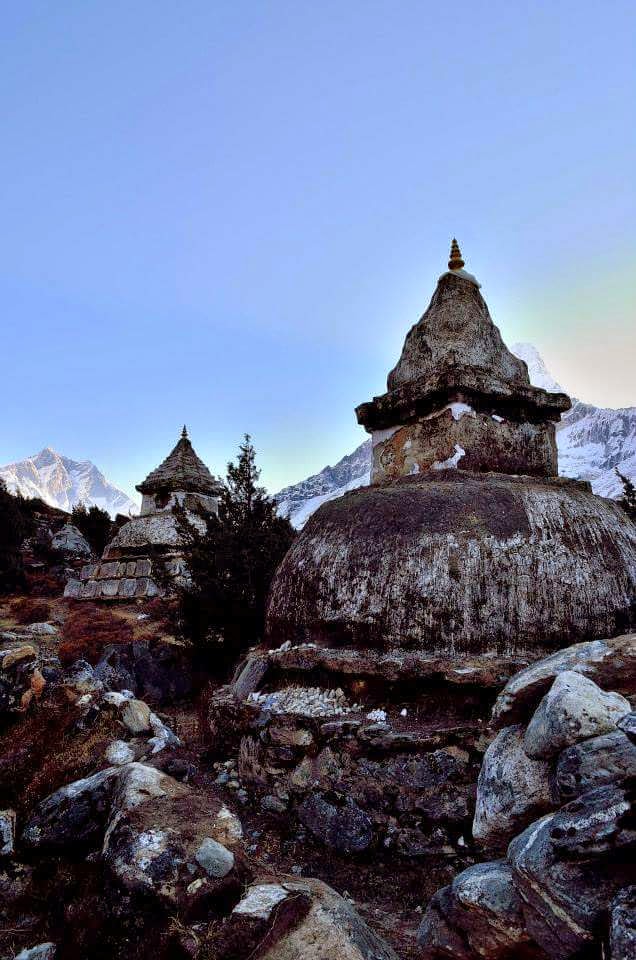
Pangboche is home to a very small, very old monastery. Older even than the more famous monastery in Tengboche. Upon entry into the village from our camp, we passed by a large prayer wheel that is continuously turned by the water rushing beneath it. Mani walls line much of the short walk there and we see also two small stupa fallen into varying stages of disrepair. As with all Nepalese villages visited thus far, prayer flags hang from almost every rooftop and from the trees. Yaks also populate the small paddocks and they wander freely the narrow streets, occasionally to be shooed away by one of the villagers.
The people of Pangboche and Portse are, according to our leader Meet, Sherpa climbers. These are the people that take Westerners to the summit of the great peaks such as Ama Dablam, a technical peak more difficult than Everest. They are a small and hardy folk, with the wide, flat faces of their Tibetan heritage as it passed into this valley 400 years before.
(Postscript: Leaders, sherpa guides, cooks and porters supporting non-technical treks in and around the Khumbu region are often from the mid- and lowlands. It is not uncommon for them to be sustainence farmers that find work during the busy tourist trekking season to better support their families and send their children to be privately educated that they can live a life of greater choice. Our leader was from the Annapurnas, while our guides were a few days walk further down the valley from Lukla.
Sherpa people from Khumbu are generally accepted as being climbing guides and elite mountaineers supporting more technical treks and climbs at higher altitudes. Their greater acclimation could be attributed to both genetic high altitude adaptation as well as being born and raised at higher altitude and therefore having a greater base of acclimatisation to build upon. Climbing guides make substantially more than their less technical counterparts. Many young men from the Khumbu villages go on to be expert mountaineers but it comes at greater risk as evidenced by the 2014 avalanche in the Khumbu Icefall's Popcorn Field.)
Thursday, 5 February 2015
Weighing In
Optimus Terra HE Weekend and Terra Solo cooksets either side of a 100 gram canister and Soto Windmaster:
There are two things that particularly frustrate me when it comes to purchasing outdoor gear from Australian stores. Firstly, we are so incredibly overcharged for the same goods compared to America and Britain. This might seem more understandable when the AUD is not particularly strong as it is now, however the same was true when the AUD was greater than the USD. We experienced no saving even though the manufacturer's dollar was weaker.
Fluctuations in the trading dollar or even shipping costs cannot explain differences of a third or even a half extra added to the price of an item. Presumably the local importers and distributers are at least partly responsible for the exorbitant inflation. Perhaps even the manufacturer is selling at an inflated rate, as could be inferred by the restrictions some manufacturers place on their brands being shipped internationally by US based online stores. Whatever the reason, if it continues to be more expensive to purchase outdoor gear in Australia, I will continue to purchase my gear online internationally where the rates are more competitive and a sale is actually a sale. Britain's shipping fees are generally very reasonable and they have no international shipping restrictions (that I am aware of). They also have a better selection than many Australian retailers.
That brings me to my second gripe, and really it is only because I am trying to be so weight conscious, but Australian online outdoor gear specialists need to work on their specialty a little more. I do not classify myself a serious backpacker. I would like to be. I would like to have the funds and time to commit to some really fantastic through hikes in the Americas and Europe in addition to my African and South American aspirations. Irrespective, I look at the weight listed of almost every product that I purchase. I imagine that to be true of more serious backpackers as well. The outdoor gear store clerk is touted as being an avid outdoor gear lover and with experience in the field and yet they sell gear often with little care for the person who will have to lug it around.
If you do not list a weight on an outdoor gear item online, I will not purchase it from you. Advertising yourself as an outdoor gear specialist but not making the effort to meet my needs as an outdoor gear customer will not induce me into ratifying that customer-store relationship with a money purchase. List the weight of your hiking and backpacking gear, it's that simple. Anything less is plain lax and not worth my support.
While I'm on the point of advertising weights, I confess myself pleasantly surprised that the Ultralight Outdoor Gear store not only listed weights within the product description, they made them as easily available as price when scrolling through a page of potential items so that I did not have to navigate each product page to see that one product was more suitable for my weight range requirements than another. They also provided store review of many of the products that they were carrying. The price was not extraordinarily cheaper purchasing from this store, given the recent drop in AUD against GBP, but the whole experience of using this site to select suitable replacement gear was such that I elected to buy from them anyway instead of buying local. I still prefer the quick gratification of buying at a physical store rather than await delivery but not at unnecessary personal expense, as it seems to be these days.
My package arrived from Ultralight Outdoor Gear store this afternoon and I have recalculated my base pack weight as being within 100 grams of 9 kilograms. I await only replacement of the sleeping bag liner and my first big weight cull is compete. Already I am trying to recalculate the numbers to make the most out of them. The biggest weight savings to be made (aside from leaving behind extraneous and unnecessary luxuries) are also the most expensive. Still, I find myself seriously considering the investment.
Everest Circuit Rerouted X: You Shall Not Pass!
The snow we initially encountered just above our last visit to Dole grew substantially deeper as we made the push for Gokyo yesterday. There was some debate regarding whether we should try for Gokyo at all or reroute directly from Machermo. The passage to Gokyo passing through an avalanche zone after a few days warm weather since the snow was deposited in the valley – the worst snow experienced at this time of year for 17 years, according to the locals – we relied on local knowledge and the experience of our leader and sirdar. It was clear on both our journey to and from Gokyo that there had been a number of small avalanches. Ice steps had been tramped or cut into the sides of some of these, as other trekkers or porters cut the trail earlier in the morning. We had to pass through the avalanche zone in the morning before the sun made the snow too slick. As it was, even though we re-crossed it this morning earlier than yesterday, the ice steps were not as firm and we, at times, found ourselves skidding frequently, even with our trekking poles out to assist us.
Cho La being completely closed at present and more snow forecasted, a decision was made to spend only one night in Gokyo and to forgo the ascent of Gokyo Ri to ensure we were well clear of Gokyo before it became snowed in again. After an early start of trekking at 07:00hrs, we had descended to Marchermo by 09:50hrs (the slower group arrived nearer to 10:30hrs) and had an early lunch. We subsequently departed Machermo at 12:00hrs and after an initial ascent, descended to Dole by 14:00hrs. The recent good weather saw much of the snow melted within an hour of Dole. The path had become slick with mud instead of snow slush. Being a Saturday, it was fortunate that there were not so many yaks muddying up the trail any further.
View of Gokyo Valley:
Tonight we stay at a permanent campsite in Dole and tomorrow we will return to Portse Tenga where we will take the trail up the Khumbu Valley. We will make a wilderness camp at Pangboche. Then we will spend a night at Dingboche and pick up our itinerary at Labouche, which is before Gorak Shep and Everest Base Camp.
Gokyo Ri, as of yesterday, was only summitable by mountaineers. The trail had only been broken to within 20 metres of the summit and with the snow already waist deep in Gokyo, it was even more heavily snowed in again. As unfortunate as it was not to be able to climb Gokyo Ri or pass through the Cho La, we still have opportunity to make Everest Base Camp and Kala Pattar without adding any really long days to our schedule. Today was 5 hours of trekking for the faster group lead by Basu. Had we remained in Gokyo to ascend Gokyo Ri, there would have been a 9 – 10 hour hike to Portse Tenga and an 8 hour hike to Dingboche (if we did not get snowed in). Due to melting snow, we could not have as safely departed from Gokyo in the afternoon.
The lakes of Gokyo, however, were well worth seeing and it was no great loss to pass them by twice. There are, I believe, 5 in total. We saw the first 3, the township of Gokyo overlooking the third on one side with Renjo La on the other and Gokyo Ri appearing deceptively small just up the valley in front of Cho Oyu. When the afternoon sun struck the third lake, it was a beautiful green amidst all the white snow and black rock. Truly stunning. I spent the afternoon traipsing through the paths cut by the locals, tripod in one hand, camera in the other, tyring to take a photograph that would do this beautiful lake justice and sinking waist deep into virgin snow for my troubles. (Trying to get back out of waist deep snow without using my hands must have been quite a sight as I was not long legged enough just to high step out of it!)
The perfect shot:
Surely it must be snowing in Gokyo presently. It is now after dinner and we have retired to our tents. After a good 15 or 20 minutes organising my gear on the spare bed for morning, it is still only 19:20hrs. Outside, the cloud is very low, clinging to our head lamps as we negotiate our way to the dining hall, the toilets and the tents. There was even light precipitation and tomorrow, I am told, it may rain again. All this drawing the Nepalese to the conclusion that it must be snowing at higher altitude and, therefore, it was lucky we left today before we were snowed in.
Routine has become very important to us. So much of our daily activities being outside our control or influence, we rely on the routine set for us and are as a group happiest when the routine is met. “6, 7, 8.” That is Meet’s way of informing us that we will proceed with our normal morning routine of tea at 06:00hrs, breakfast at 07:00hrs and departing camp at 08:00hrs. Washing water normally appears at our door (tent or otherwise) at 06:15 and 15:30hrs. Afternoon tea is at 16:00hrs. Dinner at 18:00hrs. Lunch depends on when we arrive at certain destinations and could be anywhere between 11:00 and 13:00hrs. We have learnt to take our own snacks for morning tea. I have a stash of mini Mars bars and Toblerone which I take one of each with me every day. Often I will take something squirreled from breakfast, like a boiled egg or peanut butter and jam on toast. I have never eaten so well as I have here, although yesterday at almost 5000m, my appetite was waning. I could hardly stomach one piece of buffalo and after that, everything else on the plate did not appeal to me. The others fared similarly.
Postscript: A lack in appetite at 5000+ metres is associated with the altitude. I personally had stomach only for soup and Pringles, and was not the only one in our group that felt that way. I think we all craved salt from sweating under the even moderate exertion of the trek.
Thursday, 29 January 2015
Packing Light
Last year, due to commitments to work and being a Maid of Honour at my best friend's wedding, I only managed a handful of day hikes with my hiking group. I regret not making the time to be able to attend any scheduled weekend pack carry trips and intend to make amends for it. As such, inspired by my new red Light My Fire spork weighing in at only 10 grams, I have attempted to reduce my base pack weight to below 9 kilograms (excluding food and water).
Luckily, I had weighed much of my gear before I departed for Nepal just over a year ago. I needed only weigh those items specific to camping and anything newly acquired. I confess that I became rather tenacious in my research and calculations as I have doggedly searched for ways to reduce weight so that I can better justify other items.
Those 9 kilograms include almost a kilogram entirely devoted to my being warm when the sun sets (down jacket and booties and lightweight polartec pants). After freezing 2 nights in a row on a mid-winter hike at Hattar Lakes 18 months ago, the mercury edging towards zero degrees Celsius beneath the clear skies, I'd rather carry that kilogram than be that cold again. So to keep the weight down, I've attempted to be clever on other savings.
The most obvious weight saving that I could make would be investing in a tent that weighs under 800 grams. At present I have a TarpTent Rainbow Double. It weighs 1300 with the optional liner (which assists with condensation associated with it being a single walled tent) and the 6 provided tent pegs. I love this tent. It is roomy and a breeze to set up. I have had the wind howling around my ears and a huntsman spider staring at me from the safety of the vestibule on the other side of the No See Um mesh, and it managed fine. And as the 500 gram saving would require approximately $400 investment, it's worth looking closer to home for weight savings for now. I will eventually make that investment, a larger tent does not warm up the same with body heat, but not right now.
I have identified another 450 grams that could be saved by much smaller investment. A 130 gram silk sleeping bag liner would be half the weight of the Sea to Summit Thermoreactor Plus liner that I am presently using (and am not entirely convinced works to the full extent advertised). Switching from an Optimus Terra HE Weekend cookset to an Optimus Terra Solo cookset and retiring a SnowPeak Titanium 450 mug would save another 160 grams although I am seriously considering making a titanium pot warmer in the style of the Caldera Cone (only to hook onto the pot set rather than wrap the canister) to improve fuel efficiency, which would reclaim some of that weight. An additional 100 grams could be shaved by modifying my toiletries system, such as a lighter cathole trowel and smaller containers for sunscreen and multipurpose biodegradable soap. And by exchanging my expensive but heavy Nalgene Wide Mouth 1 litre bottle for a Gatorade bottle, I expect to save a further 100 - 120 grams. I only want the bottle for easier water management than my Camelbak bladder and am hoping to use it as storage for toiletries and my glasses during the day as opposed to using a hard glasses case.
Caldera cone sourced from Trail Designs:
Trying to channel this resourcefulness, today I created a 13-14 gram deodorant stick by melting Rexona Crystal Anti Perspirant stick into a Nivea 4.8 gram lip balm container. Personally, I'm not ready to give up deodorant and it doubles as anti-chafe for under sports bras and other sensitive areas as discovered having previously developed terrible chafe in Nepal. I created a 30g version also which could probably used on much longer trips. This was melted down from my existing 75 gram stick. And just so that there will be no confusion and it mistakenly applied as a lipbalm, I even took the opportunity to buff the name from the tube's exterior using a four step nail block and using a Sharpie permanent texta to rename it. I also took the opportunity to halve the weight of my toothbrush by breaking it. And finally, the Light My Fire spork replaced both a folding MSR fork and spoon which were of much flimsier construction.
While these last changes may seem excessive, for little money and an interesting afternoon, I created an 80 gram saving which is the weight of my spare pair of socks or 3/4 of my spare t-shirt. I anticipate to make another 100 grams of weight savings by instituting similar scrimping measures to my other toiletries, such as using tooth powder and not toothpaste and a smaller mirror to put my contacts in.
I also tried to be discerning in what I included as my preferred carry list. Only one change of socks, underwear and t-shirt (if it is not raining, gear can be dried on the back of a pack if it doesn't dry following its rinse the previous afternoon or overnight, and odor resistant shirts have at least 2 days in them anyway). One pair of thermals and soft sportsbra for camp/night (not negotiable). I was drier in my Nepalese Sherpa poncho than my eVent Montane Athena jacket and suffered less condensation. The poncho is lighter, can be shortened by press studs when pack coverage is not required and can be worn with just gaiters (which I ordinarily hike in with my shorts, even in a Victorian winter) so waterproof pants are not required either. Although, if I were to walk through snow, I would reevaluate as I found that hiking through knee deep snow, it was sufficient to use a running t-shirt, Patagonia R1 Hoody, a Montane Windshirt, woolen buff and glove liners, and a pair of Marmont Pre-Cip Full Zip over my hiking pants.
After instituting the smaller changes, my pack will weigh in just over my goal weight at 9.2 kilograms. Those North Face polartec pants are a luxury that I'm not ready to give into yet. So too are the booties until I'm satisfied the jacket is enough. I suppose I could sacrifice my Keen Clearwater CNX sandals to gain another 450 grams if I really needed to scrimp during winter. In the warmer months, without the extra space required for the down, I do believe the space savings might actually permit me to limit myself to a 50 litre pack providing weight savings yet again which would place my base pack around 8.5 kilograms. Changing tents could further reduce this to a 8 kilogram pack in moderate weather.
I doubt I will ever be prepared to go ultralight but perhaps within the next 12 months I will be comfortably within the lightweight category, even when hiking mid-winter (in areas without snow).
Thursday, 23 October 2014
Everest Circuit Rerouted IX: Machermo Porter Shelter & Rescue Post
As rain fell in Namche Bazaar, so did snow in Machermo. It is knee deep in some places and in others maybe more. The peaks surrounding Machermo are little more than black rocks to the locals but with the recent dusting, it has become completely transformed into a valley of exquisite views. The white cut through by small stone buildings or walls, or by the heavy tread of yaks and trekkers and Nepalese alike.
The yaks intrigue us greatly to the horror of our sherpa guide, Basu. We all stand on the path with our cameras poised to capture a truly Nepalese photograph as he calls to us: “Safe side, safe side,” by which he means for us to keep to the uphill side of the trail in the event that we do get knocked over by one of these great, plodding beasts. Better to fall up the hill than down it. Although it certainly is interesting trying to step off the trail into thigh high virgin snow.
Of limited experience as I am with snow, I found it absolutely fascinating trekking through it. We passed the snow line quite early, within an hour or so of leaving camp, and I was surprised by how warm it was. I need only pull the hood of my Patagonia R1 over my head and sleeves down when the wind came up the valley. It was, otherwise, too hot to trek in a hard or soft shell. The trail was slick with mud and every step was with careful consideration. The use of a single hiking pole helped keep me on my feet when the step taken was not considered carefully enough and I skidded or slipped, most often on the declining slopes. I tried to remember to dig my heels in, but when it came to the last descent before camp – which Basu himself almost skied down in his leather hiking boots – I went off track using the deep steps made by other intrepid trekkers.
In Machermo there is an established porter refuge and medical centre called the Machermo Porter Shelter and Rescue Post. It offers porters with free accommodation and medical treatment including treatment of Acute Mountain Sickness or AMS, as provided by volunteer doctors from the UK. Westerners and travellers may utilise the medical services also but for a fee comparable to that in the US (at approximately $50 per consultation which is redeemable on travel insurance). A fee that assists to maintain the rescue post so that it continues to be free for the porters. Every afternoon at approximately 15:00hrs, the volunteers provide a free presentation on AMS, HAPE and HACE, and on the general wellbeing of the porters. For a nominal fee of 100 rupees (or USD$1.00), they will measure your blood oxygenation levels which are recorded as part of a study on normal oxygenation levels and acclimatisation at 4500m per age group. The wall was covered in names recording their value. Mine was 90-91% without Diamox (I have yet to require it); a very average figure judging by the number of names stuck to the wall against 90%. The highest in the group was 97% (on Diamox) and the lowest 80% (without Diamox). One of our porters was 97% also and the doctors were so pleased with his acclimatisation and his gear outfitting, as provided by World Expeditions, that they requested to take his photo in front of the centre.
The talk itself was really very moving. It amazed and horrified me that porters are often left to find their own accommodation at night and where there is none available, sleep in caves or under the stars. I could not imagine being so barbaric. Since the founding of the International Porter Protection Group approximately 10 years ago, tour groups more and more, have been better at outfitting and caring for their porters as trekkers with greater awareness know now to ask these questions of trekking agencies. Still, however, sick porters are turned away to make their way down alone, sometimes suffering HACE or HAPE. Only in Dole we watched on with disgust as another trekker made it clear to his porter he would rather the porter-guide not share his room that night nevermind that the porter was trying to convey to him that there was nowhere else for him to stay.
(Postscript: The volunteer doctors advised us all of an incident in which an unsupported trekker, having attended the AMS talk at the Rescue Post, came across a very unwell porter on his ascent toward Gokyo. The trekker had been unable to communicate with the porter but he soon located another Nepalese porter or guide and was able to communicate his concern that the unwell porter may have AMS. The porter was carried down to Machermo by the Nepalese porter or guide and despite being placed in an oxygen tent, needed urgent evacuation to lower altitude. The volunteers were able to fundraise the money required to evacuate the sick porter by helicopter within the day by approaching other trekkers that passed through Machermo which ultimately saved the sick porter his life. Porters often come from the lowlands and are not acclimatised when they commence trekking for a company. They are just as susceptible to AMS, HACE and HAPE and can die if they are abandoned by the tour group and forced to find their own way down the mountain because they are too sick to continue.)
Friday, 17 October 2014
Buying Up Big
It has probably been for the best, however, that I postpone my trip. I have not been able to commit to training as I had expected. An aggravating case of diverticulitis, then costochondritis, my best friend's kitchen tea and hen's night, my boss going overseas and an interstate visit from my mother have all adversely impacted on my time and ability to train. I had been training for another half marathon when the diverticulitis sidelined me on the couch and it has been a downward spiral since. A new pair of Asics GT1000 2s, swimwear and the coveted Suunto Ambit3 Peak Sapphire heart rate monitor later, my good conscious (and significantly poorer pocket) cannot allow me to sit idle any longer. And who would want to with all those new toys to play with?!
Of all my recent investments, I have to say that the Suunto Ambit3 is the finest and most exciting. While I have had it for only a handful of days, I am utterly enamored. As a female, it is bulky on the wrist but I purchased the larger Peak model for the purpose of hiking as well as for its functionality as a HRM. The inbuilt GPS is certainly an advantage. My Polar RCX5 required the GPS device to be worn on my arm which often equated to another source of chafe. While the Polar HRM was of a similar size (only 4mm smaller), the Suunto is certainly heavier at twice the weight (a whopping 92g total!) but it is not a nuisance for all of that. Indeed, all the little features are well worth it. I have been eyeing the activity tracker daily and cannot wait until I have justification to use the altimeter on my next hike.
As for the shoes, I cannot deny that Asics have been my runner of choice for the past decade. While the Kayanos model have always served me well in the past, I have struggled a lot in the past 18 months with what I believe is deep posterior compartment syndrome. Undiagnosed but consistent with its symptoms, swelling to my lower calves generally occurs within the first kilometer and the pain (read: the sensation of the muscle trying to explode through the muscle sheaf) does not numb until approximately the fourth or fifth kilometer. It does not seem to matter if I rest or not, which is a nuisance. I have also recently been getting arch pain which I attribute to the greater arch support of my Orange Superfeet in my Scarpa Mythos Tech GTX hiking boots making my arches lax.
My last pair of Kayanos having reached their retirement, I elected to have my gait analyzed (as far as can be done so in a store setting) at Running Fit's Shoe Lab. The verdict: I have high arches and mild overpronation (both of which I was already aware) and I was fitted out accordingly with inserts as well as the GT1000 2. Having trialed my new shoes for the past few weeks, however, I have come to the conclusion that even with all the arch support and pronation correction, it is my running style that must change.
I am a heel runner (read: jogger). I had been consciously trying to run a little further forward on my sole to reduce the strain and swelling in my lower calves and it had been helping but it is not enough. So I've taken it upon myself to try to run more on my toes. I should say that I am a slow runner; I run for distance and not time. I ran the distance of a half marathon in preparation for Nepal and I am training to do so again. I would like to run faster but my preference is always to run further and if that means I sacrifice time, I'm ok with that. Running on my toes is an interesting experience but certainly not unpleasant. The pressure seems almost wholly contained to the upper calf area. I do not experience any swelling in the lower calf area or cramps in my arches, and even the pressure on my thighs seem reduced. I feel lighter on my feet. Resuming heel running after toe running feels like running through sand, slow, heavy and trudging. I hope that slowly building up endurance to toe running will be the cure to the issues caused by my heel running. And who knows? Maybe I'll even run faster for it.
When I'm not running, I'm swimming. I have foregone weight training for the moment, preferring cardio instead. In the new year I'll reintroduce weights but for the meantime it's all about the kilometers and endurance. While I know that I do not need to be as prepared for trekking through Peru and Bolivia as I would for Mount Kilimanjaro, I want to be well prepared all the same. There's no need to suffer the trail unnecessarily when the hardest thing about the trip was your training for it. I know more than one person that could have benefited from that mantra.
At any rate, I'm now left to source a Power Monkey to charge my Suunto Ambit3 watch before my next trip. I think I'll add that to my Christmas wish list, seeing as the watch was an early birthday present to myself.